The library at Addisco is a lovely place to be. That is, if you like books and are interested in Latin and ancient Greek literature; you will not find The Seven sisters here, unless it someday will be translated into Latin or ancient Greek.
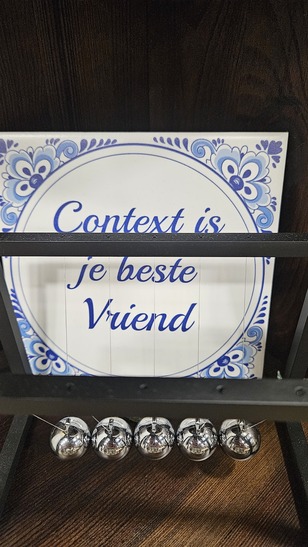
Besides an impressive book collection gathered in beautiful bookcases across all the walls (including a ladder to reach the top shelves!😍) the library contains some typical Dutch tiles with wisdom phrases on them. One of these tiles drew my attention:
Context is your best friend
I frequently get asked: how do you say in Spanish 'I was'? Without context I cannot answer that question. Context also matters when receiving language input: the context explains the meaning of an unknown word, sometimes the context explains an entire sentence. No or little attention to context makes that you get lost in translation.
That's exacty why the stories in CI are so effective. With TPRS you create a story with your students, using Storylistening you tell a complete story, Picture Talk shows a part of a story and the video in Video Chat shows you an entire story, PQA conversations are stories as well, even just talking about the date or the weather could have a story behind it.
That's why I was relieved that Casper at Addisco instructed us not to write while he did Video Chat in Latin; when you write and try to listen you miss the context and therefore the meaning and you don't know (exactly) what the story is about. The fact that some students did write while trying to listen and soon did not follow (part of) the story, was proof enough.
Not just in the meaning (translation) does context matter. Also when explaining grammar the context plays an important role. Many CI teachers use grammar pop-ups: short explanations of a language pattern, for example verb endings. Grammar pop-ups are done within the context of that word. I can't say that in Spanish the 's' at the end makes the second person singular. It does so in 'quieres' but not in 'casas'. But the explanation that the 's' at the end of 'quieres' means 'you singular' clarifies this particular context.
Context also matters in words with different meanings: 'can' when you're talking about a can of soup is something completely different than 'can' in 'can you come here, please'.
Help your students to value context in a language, so that they can pay more attention to it and next time ask: how do you say in Spanish 'I was' when I want to say 'I was on vacation'?